
 Jocelyn Seamer Education
S7 E7 - Why Your Spelling Approach Might Be Working Against You

Hello, hello, welcome to this episode of the Structured Literacy Podcast recorded right here in Burnie, Tasmania, the lands of the Palawa people. I'm Jocelyn, and today I want to have a really honest and difficult conversation about spelling instruction. We're not going to be talking about spelling tests or lists, we're not talking about Friday dictation (that tells us very little). I mean the actual teaching and what the research tells us it really should look like, what it often looks like in practice, and what happens when there's a significant gap between these two things.
Focusing on Years 3-8
So I'm going to be framing this conversation particularly around upper primary and lower secondary, that is, Years 3 to 8, because I think that's where some of our biggest unfinished business in structured literacy sits. We've done a lot of really important work in the early years; we've got phonics screening checks, we have systematic programs, teachers in Foundation to 2 are in many schools much better equipped than they were five years ago. Now the job's not done in the early years for sure, but in Year 3 to 8, that's where students with unresolved gaps are quietly, or not so quietly, struggling through every single day. And I know this because that's what teachers tell us. In our work, we spend time helping schools unpack their data, talking with teachers and leaders about the struggles they have and helping them work out simple solutions that get everyone learning. So that's where we're going to spend our time today, thinking about the Year 3 to 8 space.
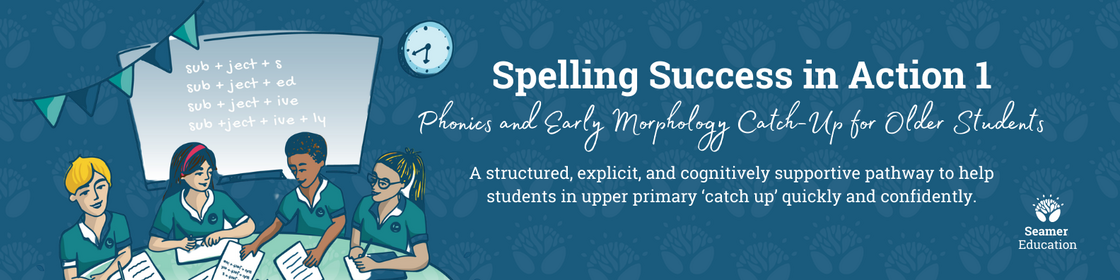
Spelling Success in Action 1
I'll also be doing something that I rarely do, which is talk quite a bit about our own programs. Now we recently published Spelling Success in Action 1, a program component that we have designed specifically to address the issue of gaps in student phonics and orthographic knowledge, that's the spelling rules, for students in Years 3 to 8. But I want the evidence to come first. It always comes first: when we create a program, when we're making a podcast, when we're helping a school solve problems, the first port of call is, What does the available research tell us? And let's be clear, research doesn't answer every question we have, but it can give us guidance that gets us headed in the right direction. When we understand what the components of really robust instruction are, we can evaluate our approach or a potential program, including the one that we have just recently launched.
So this episode is in two parts, one part was just way too long, and so we've divided it into two. And today I'm focusing on the research about what the evidence tells us about spelling instruction, not just what is important, but also the how. We're going to talk about the reading-writing connection and what good instructional design actually requires. In the next episode, we're going to get really practical. I'm going to share four student profiles that we see coming up again and again in classrooms, and we're going to talk about how to respond to them.
Spelling and Word-Level Knowledge
So let's start with something that I want Year 7 and 8 teachers in particular to hear, because I don't think that this gets said clearly enough. If you are a secondary teacher trying to teach students to write essays, engage with complex text, and produce work that reflects the student's genuine intellectual capability, and you are finding that a significant number of students simply can't do this, I want to suggest that spelling and word-level knowledge may be a much bigger part of the picture than we typically acknowledge. And I'm not here to say that Year 7 and 8 teachers are clueless because you're not. But what I do know is that if we primary school teachers have been poorly equipped to manage this in the primary school, that secondary teachers have been even more poorly equipped. So we understand that there's a recognition of these lack of skills, again, because we're talking with teachers every day. We are also working with secondary schools in the Year 7 and 8 space to help fill these gaps. And we see it in the data as well. So many students, far too many students, arrive in Year 7 with unresolved gaps in their phonics knowledge and their understanding of how words are constructed. They can't reliably decode unfamiliar words when they're reading. They can't spell accurately when they're writing. And because spelling is not yet automatic for them, the cognitive load of putting words on the page is consuming all those cognitive resources that should be available for thinking and arguing and organising ideas. Even students who look like they're good spellers can come completely unstuck when they have to read and spell unfamiliar words.
Now, Berninger and colleagues have been really clear about this, as have many others, such as Steve Graham. Automaticity in spelling directly frees up working memory for the higher level processes of writing composition. So when spelling is not automatic, text composition suffers. Reading comprehension suffers. It's not a small effect either. And for students who are already managing the additional cognitive load of reading difficult texts, this all compounds really quickly.
The Struggle in Practice
So what does this look like in practice? It looks like students who choose simple words in their writing rather than the precise word they actually want to use because they're not confident that they can spell it. It looks like students who write short sentences because longer, more complex ones require holding more information in working memory at once. It looks like students who avoid writing altogether when they can get out of it. And it looks like students who are disengaged or being "difficult" when they're actually exhausted by years of not being able to do things that they think everybody else can do without any effort at all.
Whenever I'm in the classroom with older students, I say, put your hand up if you have interesting things to say when you write, but you don't write them because you aren't sure of how to spell the words. And you know what? Just about every hand goes up, every single time, no matter the socioeconomic background of the school. Then I say, keep your hand up if you write words and they don't look right, so you put an E on the end, hoping that will fix it. And so many hands stay up, and yes, there's a little bit of giggling that goes along with that one. But what we're seeing is a lack of confidence in spelling. And this lack of confidence, this lack of understanding of how words work, is a real problem that teachers are encountering every day. And it impacts every single curriculum area.
This problem is not going to fix itself
Students who arrive in Years 3, 5, 7, or 8 with significant word level gaps and do not receive the explicit, systematic instruction they need, are not going to catch up through exposure to good literature and writing tasks. They will develop increasingly sophisticated strategies to hide their problem, and they will move through secondary school carrying a cognitive load that is genuinely unfair to them. Now the good news, and there is really very genuine good news here, is that the brain remains responsive to high-quality instruction well beyond the early years. These students and their lack of this foundational knowledge are not a lost cause. They just need teaching that's straight to the point, engaging, and delivered in a way that meets them in the Goldilocks spot: not too easy, not too hard, just right.
And on that point about it not being too late for them, the oldest person I ever taught to read was 62 years old. And when I showed him the I, the G, and the H and said, when you see this, that spells the sound I, he said, Why didn't someone just tell me that in the first place? So it is never too late to build foundational skills that will help empower people, regardless of their age.
Why Reading and Writing?
And before I go further, I want to address something that might be sitting in the back of your mind. Because this podcast episode is about spelling. And we've just released another element of our spelling program. So why have I been talking about reading and writing? Here's why. The research is very clear that phonics instruction is the primary mechanism by which students who are at risk of failure develop accuracy in reading and in spelling. And that's not just true in Year 1, it's true for struggling readers of all ages. When students can't reliably decode unfamiliar words, words they can't recognise from memory automatically, they guess, substitute, or skip, and they do it for reading and for spelling. And the texts that we want students, older students in upper primary and secondary, to read and write are full of the words that they find the most difficult to spell and read. And here's the bit that is particularly compelling, and we have a whole podcast series on this, a Research to the Classroom about connected reading and writing instruction. Spelling and reading draw on the same underlying orthographic knowledge and morphological knowledge as well. When students practice spelling a word, actually encoding it, not just copying it, they are strengthening the same neural representations they use to read it. That comes from Linnea Ehri, who you may not have heard of her directly, but I bet you've heard of orthographic mapping.
Spelling practice is reading practice. That's why we always say include as much spelling in a lesson as you have word reading. These are not separate skills. They're not identical, but they are two sides of the same coin. Timothy Shanahan describes this as, we build the knowledge like in a well, and then we have two buckets that we dip in, one for reading and one for writing, connect these things together, and we're going to get much better outcomes. So when we invest time in appropriate spelling instruction for older students, we're getting a really nice extra. We are directly building the foundation of reading accuracy as well. And for the students sitting in orange and red in your screening data, that foundation work is not supplementary, it's the main event. It needs to be the core instruction delivered several times a week, ideally four or five, for a large enough amount of time and done in a way that's targeted to their needs.
And of course, this has a direct implication for writing, because if a student can read unfamiliar words accurately, they encounter more vocabulary. When they can spell accurately, they write more freely. When they write more freely, their composition improves. All of these things are not separate creeks or rivers, they all flow from the same source.
Instructional Design
Alright, now let's change tack a little bit and talk about instructional design, because I think this is the next frontier in education. We, and I say we broadly, in education, have so many boxes of the "science of reading" (in air quotes) being ticked. The what is being covered. But we are still very far away from getting things right from an instructional design perspective. And please understand me, I'm not criticising teachers, I'm just naming up the situation that I see. I think of teachers like builders: they need lots of skills, lots of knowledge, and there's absolutely expertise that is developed over time. But teachers are not architects. Educational architecture involves a different skill set. And frankly, one that I've spent years developing and one that I want to unpack a little here so that you have a framework for evaluating whatever instruction is currently happening in your school.
A lot of spelling programs do break content down into small parts, that's one of Rosenshine's principles that you're probably familiar with. And that is, in principle, aligned with cognitive load theory and Sweller's work on managing the demands of working memory learning, small steps are good, explicit instruction is good. I'm absolutely in favour of both of those things, of course. But here's the issue that I'm seeing in practice: much of the time, lessons are broken into smaller parts, but then students are presented with so many different small parts in such rapid succession that the lesson becomes a bit of a revolving door of concepts. You might have a new grapheme introduced, a new suffix applied, a new convention explained, all within a single lesson. Now each element is theoretically small, but the total load is high. And for students who already have insecure foundations, the working memory cost of managing all of that simultaneously means that very little is actually consolidated. And let's even think about that across a week. All of those different parts might not be tackled within the one lesson, perhaps they're built over successive days, however, what's happening is students are not being given enough time and repetition in a variety of contexts that slowly builds over time to encode that new information into their long-term memory. The lesson or the unit looks busy, the students look busy, but the learning doesn't land. And the next week or the next fortnight or the next term, when you want to come back and use what you think you've taught, you find that most of it, if not all of it, has already faded.
Cognitive load theory is really clear on this, the goal of the instructional design piece is to manage the total load on working memory, not just the size of all the individual components. When we layer multiple new concepts into a single lesson, even lots of small ones, we can easily exceed what working memory can handle, especially for students who don't have strong prime knowledge to scaffold that new learning. Now, when we have established schema or long-term memory for something, we can layer in many elements. And the challenge for the student then becomes coordinating them to achieve a particular outcome. That's fine, that's desirable difficulty, but when we are first learning something, the goal has to be instructional precision. And I really feel like I need to trademark this term: instructional precision, one concept, taught well, practiced deeply. And you may have heard me say over the years that we get much better outcomes for students when we go an inch wide and a mile deep versus going an inch deep and a mile wide. We feel good because we got to tick off lots of things from the scope and sequence or the curriculum, but all of the learning has been nothing but surface-level short-term learning, and therefore it's not learning. Because remember, learning is a permanent change to long-term memory, thank you, Mr. Sweller.
Instructional Intensity
The second issue I see is instructional intensity. Now, some programs teach a pattern using very few words and then just their immediate relatives. For example, erupt, erupted, eruption. Now, teaching those three forms in a lesson will help students learn specific words that relate to eruptions. But that is much closer to a vocabulary lesson than a spelling lesson. In a spelling lesson, we want students to internalise and remember the patterns, whether that's phonics or morphology. In order to do that, we have to see the pattern across multiple different words, across multiple different encounters, across multiple different days, and with context. So if we want the students to learn the base 'rupt', they need words like eruption, disruptive, corruption, bankrupt, more than once and with meaningful context built in. That volume of exposure is exactly what allows the brain to learn the pattern 'rupt' and generalise it to new words. Teaching just one word and its family is item-specific learning. It doesn't build schema for the main thing we wanted the children to learn.
And this matters most for students who struggle. Students with reading and spelling difficulties don't generalise learned patterns to new words as easily as their more fluent peers. They need to see more examples to get a pattern, not fewer. A program that only has a few words is actively working against the students who need the instruction the most.
So when I think about what genuinely effective instructional design looks like, reflecting on both the cognitive sciences and the literacy research, I come back to a few key principles.
- One concept at a time taught well and practiced deeply.
- Multiple words, not three, but more like 13 or 15, multiple words representing the pattern, not just that one base and its family.
- Metalinguistic complexity or how much of the added linguistic or language elements are included, needs to be managed deliberately, particularly for students who are still building foundations.
- And there needs to be enough time within the lesson and across the week for genuine encoding to happen, because the encoding doesn't happen unless the students have done the heavy lifting on the thinking. And you can't get that with a snappy, snappy, snappy speed lesson that goes at a million miles an hour.
- And you can't get that in a lesson where the teacher is taking the students on a tour of content and occasionally getting them to do some things.
- And you can't get that in a lesson where the intrinsic load of the task, how hard or easy it is, hasn't been carefully managed to find that Goldilocks spot.
So the question we want to ask is not, are we breaking things down into small steps? It's does the total load of the lesson across all of those small steps remain within what students can actually hold and process in a way that is optimal for learning? That is a meaningfully different question, and it's one worth sitting with, and it's one worth asking, and it's one worth answering honestly.
It's Not a Lost Cause
So that's where I want to leave things today. The evidence is clear. Spelling gaps in upper primary and secondary are not a motivation problem. They're not a lost cause. These kids are never a lost cause, there is no such thing as a student who is a lost cause. What we have is instructional issues. We have systems and structures that are not supporting the students in the way that they need to be supported. And a program is part of the system and structure of your school and how it works. All of these problems are entirely solvable. But solving them requires instruction that is precise, that manages cognitive load deliberately, and that provides enough volume of practice for patterns to generalise, with lots and lots of reading and spelling, more importantly, that the students are actively thinking about the words and they're using them with some context, not writing full narratives, but there's context involved so the meaning connections can be made so that these words stick. And when we do this work, great things happen.
Now you might be thinking, Jocelyn, that's all very nice for you to say, but you haven't seen our data, you haven't met our kids. We have a relatively small school with kids with all of these issues, or we have whatever the issue is in our context. And I'm coming to you from this perspective. I've done it. In my own work as a school leader, in the schools that I have led, and the work that I'm now supporting other schools to do, I have actually done the work in circumstances that were not just difficult, they could have been called almost impossible. In the last five years, I've also had the headspace and the time to learn, to read deeply, to be able to ask the question: what does the research say about that particular thing? And how do we incorporate that with our professional understandings and the way that we work? I'm not coming to you with pie in the sky ideas. That's a nice idea, but it has no backing and no one's ever really been able to do it in practice.
Next Time...
In the next episode, we're going to unpack a few more elements of quality instruction, and I'm going to get practical. I'm going to walk you through how to identify the profile of the students sitting in your classrooms and how to match instruction to those profiles. Also, I'm going to share some more about the specific design decisions behind Spelling Success in Action 1. You're also going to have a set of reflection questions that you can use to evaluate your current approach right now. But start with that reflection about are we actually getting the cognitive load of the instruction right from the start in terms of how many elements are included in a lesson? And is this right for our students?
In the meantime, if you'd like to download the free early morphology diagnostic assessment, that will tell you whether your students really understand suffixing conventions, the drop the E, the Y to I, and the doubling rule, you can get that on our website, just go to the Free Resources tab and you'll find it there. Data is a great first step to understand where your students are actually up to. If this episode has been useful, I'd love for you to share it with a colleague. That's how we help grow our collective understanding and collective efficacy. Thanks so much, everybody. I'll see you next time. Bye.
Show Notes:
Spelling Success in Action 1: Phonics and Early Morphology Catch-Up for Older Students
S5 E9 Research to the Classroom - Connecting Reading and Writing - Part 1 (The Research)
S5 E10 Research to the Classroom - Connecting Reading and Writing Part 2 (Practical Application)
S5 E11 Research to the Classroom - Connecting Reading and Writing Part 3
Want to address the issue of gaps in student phonics and orthographic knowledge in Years 3 to 8? Click HERE.

0 comments
Leave a comment