
 Jocelyn Seamer Education
Figuring Out Fluency

If you teach in Australia you are a little more than half way through the first term of 2022. You’ve gotten to know your students and have identified their strengths and weakness in reading. For some children you will have noticed that they can ‘read’ but they are lacking fluency.
The first thing to note is that fluency is not an activity we do or a specific skill to develop, it’s the product of great reading instruction across a range of areas. However, a quick search online for fluency activities may well lead you suggestions such as “Use silly voices when reading” or “Have a reading competition (with yourself)”, neither of which I think are very useful.

We also need to know that fluency isn't just about rate. The three areas of fluency that we need to understand are:
Accuracy (how correct you when reading)
Rate (how fast you read)
Prosody (expression and phrasing)
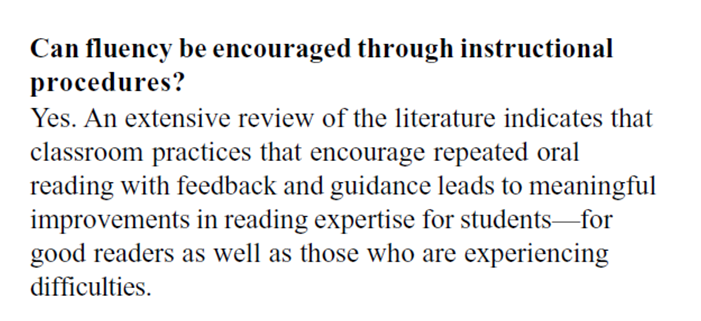
To understand how to help students with fluency challenges, it’s important to understand what the root cause of the fluency breakdown is. When a child has struggled in this area in the past, our response has typically been repeated reading. Now repeated reading has been shown to be effective. See the recommendation from the National Reading Panel report below (NHCD, 2000). Note the inclusion of ‘with feedback and guidance’. It’s not just about silent reading in the classroom.
But repeated reading by itself is not sufficient to really get to the heart of the fluency breakdown for our students. To do that, it is useful to go through the following list of questions and identify where the wheels have fallen off for your student. With all of the questions below, consider whether these skills are automatic and effortless.
- Does the student have the phoneme grapheme correspondence of the code you are asking them to read with?
- Can the student blend single syllable words accurately and with automaticity?
- Can the student blend compound words?
- Can the student read multisyllable words (human, baking, worry)?
- Does the student understand the changes that arise in spelling from adding suffixes to words. For example, do they know that when adding the vowel suffix ‘ing’ to the word ‘bake’ you drop the e and then add the suffix? Some students will just ‘pick this up’ but many require systematic and explicit study in this before being able to tackle these words in text.
- Has the student been encouraged to guess words in the past? Is it a case of paying attention all through the word?
- Is the student trying to rush and be ‘fast’. (Remind them that first we are accurate, then we are fast.)
- What level of word complexity is the student struggling with? Single syllable, multisyllable, loan words from other languages and what exact instruction do they require to be automatic in reading these words?
- What level of sentence is the student struggling with? (Simple, compound, complex)
- Does the student have the words in their spoken vocabulary? (This is actually really important)
- Does the student properly attend to punctuation?
Practices that promote reading fluency
Once you have discovered the cause of your students’ fluency challenges, you need a solid plan for how you are going to tackle it. If you have discovered that your students are struggling to read long, complex sentences, you need to provide explicit instruction in how to understand and read these. If you have assessed your students phonics only to discover significant gaps in phonics knowledge, this needs to be addressed.
Here is a list general practices to promote fluency.
- Ensuring strong word level reading through our phonics lesson and the inclusion of both blending and segmenting daily.
- Promote language learning through explicit vocabulary instruction and the creation of a language rich environment. After all, students will read words more fluently if they already have them in their spoken vocabulary. This is also critical for students to be able to take advantage of ‘self-teaching’.
- Providing appropriate, explicit morphology instruction from the Foundation year. This teaching can be simply embedded inside phonics lessons to start and then deepened further in year one and two.
- Ensure that you are aware of your students’ reading needs and goals so that you can make them aware of what they need to do to improve their reading. Specific and effective feedback is required to help them know when they are on the right track and when they need to adjust.
- Model appropriate prosody through oral reading daily and make students aware of the role of punctuation.
Remember, students need to have reading fluency at grapheme, word and sentence level in order to read well at text level. Before going down the silly voice road, examine all of these factors so that you can pinpoint exactly what areas you need to help your students develop.


10 comments
Leave a comment