
 Jocelyn Seamer Education
The Motivation Myth

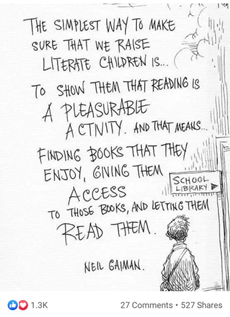
I woke a few days ago to this image having been shared by a teacher’s page on Facebook. It should have come with a trigger warning because reading it certainly did raise my heart rate.
And here’s my smarty pants reaction
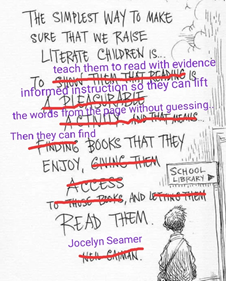
You might be wondering why I would be opposed to children having access to great books. The truth is, I’m not. Of COURSE I want every child to have access to books that ignite their imaginations and take them anywhere in the world they want to go. Of COURSE I want that access to be easy and free and equitable. And of course, engaging reading material that children can get excited about is a must. Nobody wants to be stuck with boring stories. They don't inspire anyone to feel or do anything at all.
The reason that this quote ticked me off was that it wasn’t shared by the author in its original context (which was a comment about library closures, not reading instruction). It was shared by a Facebook page that reaches many, many teachers. You can read an extract of the author’s excellent speech which was the source of the quote above here.
But let’s come back to the reason that the sharing of this quote from a teaching page is problematic. When these kinds of quotes are shared, it can be easy for them to be used as a justification for some educators, academics, authors and commentators to continue to promote the belief that immersing children in great literature will make them readers; that if reading is ‘fun’ and children have a strong enough motivation to read something, they will be able to do so. And if you think I’m paranoid, have a talk to the parents of children with Dyslexia and other challenges that make it harder to learn to read. Every one of them will tell you their own story of a conversation that probably went something like this,
Teacher: Did you read to them when they were little?
Parent: Yes. Every single night.
Teacher: What kinds of things do they like to read now?
Parent: Nothing. They find reading difficult and frustrating.
Teacher: Oh, well let's see if we can find something they'll like. What about a motorbike magazine?

Parents aren't the only ones frustrated by these messages. Teachers are also disadvantaged by them. If you are teacher, I invite you to participate in the poll below.
So where are these messages coming from? Well, from everywhere. We hear it in our schools, at our professional learning sessions and from well-known personalities who we admire. Have a read of the quote below:
If every parent understood the huge educational benefits and intense happiness brought about by reading aloud to their children, and if every parent- and every adult caring for a child-read aloud a minimum of three stories a day to the children in our lives, we could probably wipe out illiteracy within one generation. Mem Fox.
Mem also argued in her 2008 speech, ‘The Folly of Jolly Old Phonics’ (that is available for you to read on her website) that phonics is useful after we learn to read but is not essential in learning to do so in the first place. Mem Fox writes beautiful books, but her thoughts on education are not in line with the research evidence.
Arguments such as these are flawed for so many reasons:
- Firstly, research evidence (as outlined in the inquiries from the US, the UK and Australia) shows us that the most reliable way to help young children learn to read is through systematic, explicit instruction.
- While some children will come to school already reading Harry Potter, most won’t. Many children will be ‘ok’ with broad instruction but many, many children will not become proficient readers unless they receive the kind of instruction that we now call ‘systematic and structured’.
- Reading to children is wonderful and its impact on language and concept development can’t be denied, but it is not a replacement for actually teaching children to read.
- Reading is not biologically primary. We aren’t hard-wired to just pick it up the same way we are with speaking and listening. Reading is biologically secondary and needs to be taught intentionally and explicitly.
- Perpetuating the myth that motivation is the key to children learning to read squarely places the blame for reading failure at both the parent’s and the individual child’s feet. If parents are good parents and read enough and if children are motivated enough, it will all happen. It’s just so unfair when we know that instruction and teacher knowledge makes the biggest difference.
- Myths such as these also leave teachers, who are busting themselves to do a great job for kids, without the knowledge and skills they need to teach all children to read effectively. We go to work every single day with the genuine desire to make a difference, only to find that our efforts yield poor results for some or many of our children and we have no idea why. No wonder teachers leave the profession!
- We don’t have a moment to waste. While we are scratching around trying to find the ‘right books to engage the child’ and focusing on all the things that won’t make a difference, we are losing precious time that could be used to teach in ways that will move the needle.
Last weekend I spent two days with teachers and parents supporting some of our most vulnerable students. They told me story after story of their attempts to help with reading and their frustration at being denied access to evidence informed instruction. No teacher, school leader or regional curriculum officer gets out of bed thinking, “I’m going to choose to only teach some of my children today”, but there are many, many people who find the idea of change confronting. The challenge of change is one we all need to embrace, and we will only be able to do so if we invite our whole profession onto the bus. Sometimes it feels like it will never happen, but if we keep the evidence in mind and are there to support each other, we can make great things happen. Stay open, stay curious, think critically and remember that change is not about us. It’s about the children in our care.
If you would like to know more about what systematic instruction looks like in the classroom, have a read of this post, “Where do I start”.
To find out when new blog posts are published, enter your details below.

6 comments
Leave a comment